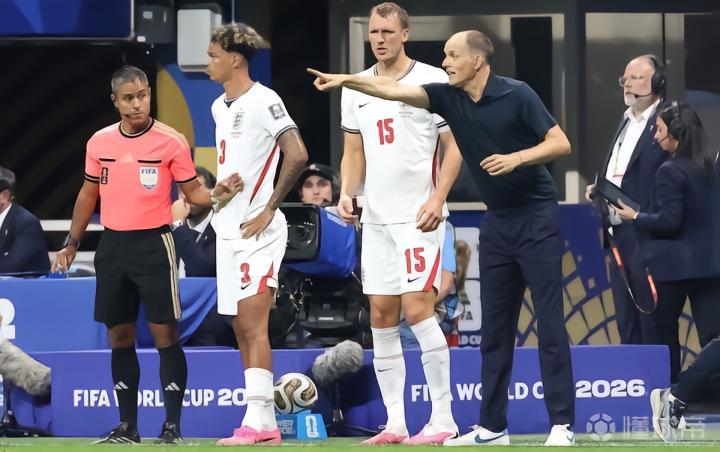
According to the Daily Telegraph, Liverpool legend John Barnes believes that Tuchel should not be solely blamed for England's failure to reach the World Cup final; poor player performance was also a significant factor.

John Barnes has waited 53 days to express his opinion. Now that the opportunity has finally arrived, he won't miss it.
This interview was originally planned to take place shortly after England's loss to Argentina and failure to reach the World Cup final. Barnes enjoys debating and relishes the back-and-forth of high-quality football arguments; he never shies away from expressing his opinions.
What got him talking so enthusiastically at a breakfast table in a coffee shop near his home on the Wirral Peninsula was the widely held belief that Tuchel's substitutions in Atalanta caused England to miss another chance to win a major men's tournament.
“I bet you were all chanting ‘Tuchel out!’ back then, weren’t you?” he asked, a mischievous glint in his eyes, ready to launch into a long analysis. I immediately told him, “No.” I explained that my doubts about the coach stemmed from multiple matches over a period of time, not just a single 90-minute game.
Barnes raised an eyebrow. "You'll soon know the next hour is going to be interesting." He suddenly rearranged the salt shaker, pepper shaker, car keys, and two glasses of water, using them as a tactical board. The plate of boiled eggs, smoked salmon, and avocado in front of him was also pushed aside.
He began to meticulously analyze the series of key events that followed Anthony Gordon's opening goal and dismantle Tuchel's decisions. There was a prevailing opinion that Argentina's substitutions gave them six attackers on the field simultaneously, but Lionel Scaloni simply made like-for-like substitutions.
Barnes believes that Tuchel effectively only has four substitutions when England are defending their lead: Gordon, Morgan Rodgers, Kane, and Bellingham. But as he points out, with little time remaining, will Tuchel really substitute his captain or the team's best player?
"Why blame the manager when everyone retreated to the six-yard box and Enzo Fernandez got a shot off from 20 yards out?" Barnes asked. "People will say, 'They retreated too far, Tuchel should have reminded them!' Do you think Tuchel didn't do that?"
"Do you really think Tuchel would tell the players to stand near the six-yard box based on training, warm-up games, and everything the team does? Of course not! So why should we blame Tuchel for that?"
It should be noted that Barnes is not trying to curry favor with anyone within the England team. He has stated several times that he would not enjoy playing under Tuchel and does not necessarily appreciate the pragmatic football favored by the German coach.
“We knew what we were going to see,” Barnes said. “It will be tough, and we won’t play very entertaining football. We don’t have Palmer or Foden. We’ve never played open football before, so why would we expect that to suddenly change in the last 20 minutes of a World Cup semi-final?”
He was now fully in form. We'll discuss later how to deal with pressure and how it can influence a player's decisions, but the narrative that emerged after the World Cup left this player, who had represented England 79 times and participated in four major tournaments, bewildered.
“As a team, we like to think we know the answers,” he said. “If one approach doesn’t work, we assume another must. We believe in ourselves, but I’m telling you, England isn’t the best team. So why should we win the World Cup?”
"Football fans all over the world think they know more than anyone else, but it's more serious in England than anywhere else. We don't just think we know more about football, we think we know more about life. Look at the history of British colonialism, and we think we're better than everyone else in the world. The current narrative is that Tuchel replaced the wrong person. So we need to find a scapegoat, and everyone needs to talk about it."
“You might think I made this up, but I assure you it isn’t. The very next day, I was taking a walk at the nearby West Cobb Pier.”
“There were two elderly women pushing a stroller with their grandchildren in it. They weren’t with me, but I could hear their conversation. One of them said to the other, ‘Did you watch the game? Tuchel made the wrong substitution.’ Now everyone is saying that, and it’s become the so-called reality.”
"When this narrative spreads, it's called 'performative discourse.' Now everyone's starting to accept this term, and all the commentators are talking about it. I'm thinking, these commentators should understand it better, because they're all in the football world. Put the game result aside and think about it carefully."
"If you're leading 1-0 with five minutes left in the game and the opponent is attacking, would you really bring on two strikers, hoping to catch them on the counter-attack? Please! But if you ask anyone now, they'll say we lost the World Cup because Tuchel made the wrong substitutions. Who would want to be the head coach then?"
As it turns out, he would indeed be willing to coach if given the opportunity. The topic has completely shifted in another direction, but it was necessary. Barnes will turn 63 in November, but judging from his enthusiasm and passion, it's clear he misses the days of being fully engaged in his work.
After his illustrious playing career ended, he briefly coached three teams: 29 games for the Celtics in the 1999-2000 season, an 11-game unbeaten run for Jamaica from September 2008 to June 2009, and 12 games for Tranmere Rovers in the fall of 2009.
"I became a football commentator because I love football, but commentary was just a fallback," Barnes explained. "I want to be a coach. I started as a commentator to keep my feel for football, but now, almost 20 years later, I'm still spouting post-match nonsense! Many commentators don't want to be head coaches."
"The easiest thing in the world is to comment after things have happened. The manager has to make it clear before the game, 'We're going to do this,' and make the plan work. The manager has to make judgments before things happen. When the England manager chooses his squad, people only discuss it after the game based on the result and hindsight."
“I would love to be a manager somewhere where nobody really knows me. A small club where you can work the way you want, like a League One or League Two team. Nobody judges you every day, there are only about 2,000 fans at the home ground, and you have the opportunity to build a team.”
Will this happen? Who knows? It would be an incredible development in his career, but Barnes' resume is already illustrious enough. He recently ranked fifth in a poll of Liverpool's all-time best players, which speaks volumes about his talent.
Social media is filled with clips of him in his red jersey. His dance-like elegance and ball-handling skills back then would likely be worth far more than the €123 million Liverpool just paid for Barkola today, but critics always focus on his England national team career.
Therefore, it was perhaps most appropriate for the conversation to return to England, the manager's challenging job, and the ongoing pressure on the players. No one knows these things better than Barnes, but it was still surprising to hear him say that only half of his 79 appearances for England brought him joy.
“Bobby Robson was never criticized for not using me, Chris Waddle, or Glenn Hoddle properly,” he said. “We were criticized for not playing well for England. In the past, people would say, ‘You played well at Liverpool, so do it for England!’ Now that pressure would fall on the manager, but it wasn’t like that back then.”
"Many fans have made judgments about me based on a newspaper article that said I wasn't born in England, so I wasn't loyal to England. The article also said that John Barnes wanted the West Indies to beat England in cricket, so he wasn't a true Englishman."
"As a result, the outside world came to believe that I was disloyal to English football. The worst experience happened in February 1993 when we played San Marino at Wembley. I wanted to be substituted in the 10th minute because I had been hearing people booing me since the 2nd minute. The situation was so bad that I wanted to leave the field."
“But Graham Taylor told me, ‘Even if you’re the worst player on the court, even if you fall down, I’m not going to take you off.’ He said he wouldn’t let those guys get away with it. I wasn’t any worse than anyone else, but every time I got the ball, they kept booing me.”
"The next England game is still at Wembley, against the Netherlands in April. I scored a goal, and it was the most emotional I've ever been after scoring for England. Of course, that's football; the fans started cheering for me: 'We love you!'"
"I see how fans treat players who perform well, and I see how they treat players who perform poorly. If those poor players perform well, they get loved, but the player is still the same person. Does that make sense?"
"If Barnes #10 plays well, they like me. If Barnes #10 plays poorly, they hate me. So what is the reality? You give people what they want, and they will love you. If you don't give them what they want, they won't love you. That's the reality of life."
From the moment he started fiddling with those condiment bottles, this meeting was destined to be anything but boring. As a person, player, and commentator, Barnes always delivers something interesting.
Barnes discusses Tuchel's three controversial substitutions
Gordon was substituted off, and Konsa came on in the 72nd minute.
I firmly believe this is the right decision. Tuchel really only has four options to make, but he won't substitute Kane, especially considering the possibility of a penalty shootout, nor will he substitute Bellingham. Morgan Rodgers can play more in midfield.
Therefore, he brought on Konsa because he saw that with Argentina's Montiel on the field, the right-back position would provide more crossing opportunities, and Nicolás González's playing style was also different from Giuliano Simeone's.
Tuchel needs to add a center-back because Argentina will only be crossing the ball in the coming minutes. So the lineup could consist of Konsa, Stones, and Gui, plus Spence and Reece James.
Dan Byrne and O'Reilly came on, James and Rice came off in the 82nd minute.
With nine minutes remaining, Tuchel said, "Let's stabilize the situation first." O'Reilly and Dan Byrne came on; they are 1.91 meters and 1.93 meters tall respectively. This was a reasonable decision. Why even consider counter-attacks? Against the defending champions, with eight minutes left, why think about scoring again? We should focus on defense.
I've seen suggestions to substitute Gordon and Rodgers for Saka and Rashford. What difference would that make? Tuchel made the right decision. What if he had followed the critics' suggestions and we had lost 1-3?
Rashford and Tony came on, Spence and Stones came off in the 96th minute.
I've also heard another suggestion: to substitute Stones and Spence when the score is 1-1, bringing on two attacking players. Substitute two defenders under such pressure? That's absurd.
Every decision Tuchel made at the time was reasonable. They may not have worked, but they were all reasonable choices at the time.